Mexico Temporary Resident Visa for Remote Workers: 2026 Complete Guide

Mexico raised the financial bar for foreign residents in 2026, and if you’re planning to live there as a remote worker, the updated income thresholds, doubled government fees, and tax residency rules are details you can’t afford to get wrong.

Mexico Temporary Resident Visa for Remote Workers – 2026 Guide

Last verified: March 2026 | Sources: Instituto Nacional de Migración (INM), INEGI UMA 2026, MexLaw, Mexperience

If you’re planning to live in Mexico while working remotely for a foreign employer, this guide cuts through the noise. We’ve cross-referenced INM policy updates, 2026 UMA-based financial tables, and official consulate guidance so you don’t have to.

Here’s the honest summary: Mexico still doesn’t have a “digital nomad visa,” and the financial bar just got significantly higher. But for remote workers who qualify, a Temporary Resident Visa remains one of the most practical long-term residency options in Latin America.

Does Mexico Have a Digital Nomad Visa in 2026?

No. Mexico has not introduced a dedicated digital nomad visa as of 2026.

Remote workers who want to stay legally beyond a tourist entry use the Temporary Resident Visa (Residente Temporal) instead. This isn’t a workaround. It’s the official, intended route for people earning income from outside Mexico. It covers remote employees, independent contractors, and freelancers, as long as your income originates abroad.

If you’re being paid by a Mexican company, that’s a different situation and requires a separate work permit. You can review Mexico’s official visa categories on the INM tramites portal.

Who Qualifies? The 2026 Financial Requirements

This is where most guides fall short or get the numbers wrong.

Mexico now calculates financial solvency using the UMA (Unidad de Medida y Actualización), a fiscal index that replaced the minimum wage system for immigration purposes. INEGI published the 2026 UMA value on January 8, 2026. It increased by 3.69% over 2025, bringing the daily value to $117.31 MXN. The new multiples consulates apply to this figure are also higher, resulting in thresholds that are noticeably more demanding than previous years.

2026 Temporary Residency Thresholds

Qualification Method2026 Requirement (MXN)Approximate USD Equivalent*
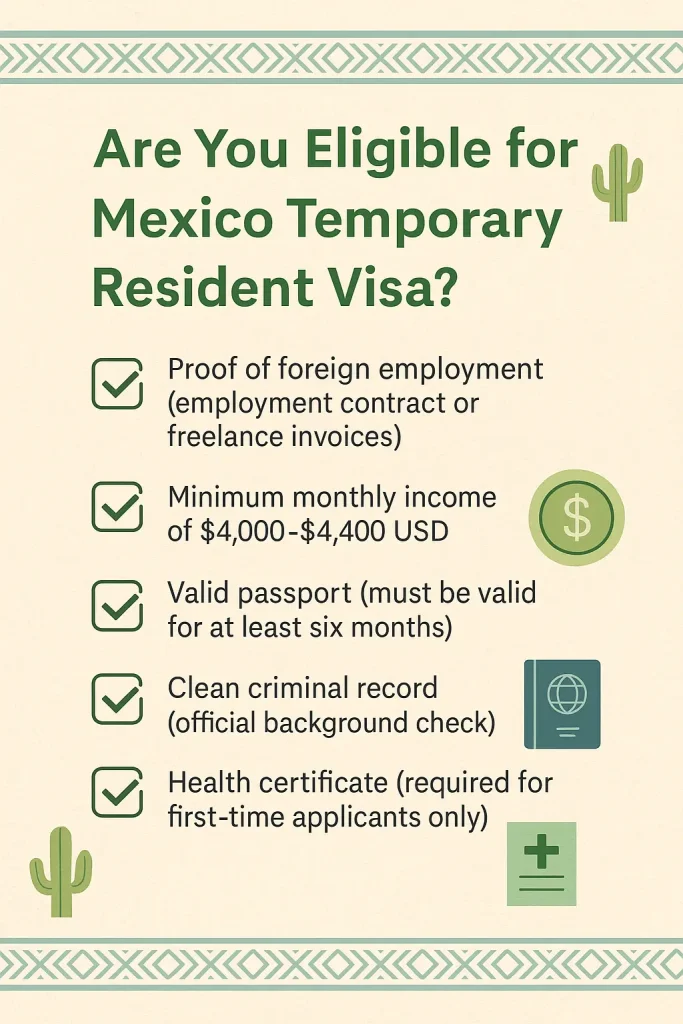
Monthly income~79,770 MXN/month (680× UMA)~$4,400 USD/month
Savings / investment balance~1,344,372 MXN (11,460× UMA)~$74,000–$80,000 USD

Based on approximately 18 MXN to 1 USD, early 2026. Exchange rate fluctuations affect your effective threshold, so monitor this closely.

These figures are confirmed by MexLaw’s 2026 solvency breakdown and Mexperience’s financial criteria guide, two of the most reliable independent sources tracking Mexico immigration requirements.

Important nuances:

  • These are legal minimums. Individual consulates can and do apply stricter interpretations. Find Mexican consulates worldwide via the SRE directory.
  • Some consulates still reference older benchmarks (e.g., 300–330× daily minimum wage). UMA is becoming standard, but consular discretion is real.
  • Home equity and cryptocurrency are typically excluded from savings calculations. Consulates want liquid or semi-liquid traditional assets: cash, bank savings, and investment accounts.
  • For every dependent you bring (spouse or child), expect the income/savings requirement to increase by approximately 20–30% per additional person.

The “no-dip” rule: If proving solvency via savings, your balance cannot drop below the threshold at any point during the 6–12 month look-back period. Even one month below the line can result in rejection.

2026 Government Fees: What You’ll Actually Pay

Immigration fees increased significantly on January 1, 2026, roughly doubling compared to 2025. These are the fees paid inside Mexico when you collect your resident card at an INM office. Consulate application fees, paid abroad at your interview, are separate and vary by location.

Residency Duration2026 Fee (MXN)Approximate USD
1 Year~11,140 MXN~$620
2 Years~16,693 MXN~$925
3 Years~21,143 MXN~$1,175
4 Years~25,058 MXN~$1,390
Permanent Residency (lump)~13,579 MXN~$755

Budget for both the consulate fee (paid abroad) and the INM card fee (paid in Mexico). Many applicants are surprised by the second payment. For renewal-specific fee breakdowns, Mexico Visa Specialist has a useful 2026 renewal fee guide.

Step-by-Step: How to Apply in 2026

The application process itself hasn’t changed dramatically. Here’s how it works:

Step 1: Apply at a Mexican Consulate Outside Mexico

You cannot start this process as a tourist already inside Mexico. You must apply from your home country or wherever you’re currently based. Book an appointment through your consulate’s official website. To find the Mexican consulate nearest to you, use the official SRE consulate directory or Mexperience’s worldwide consulate list.

Step 2: Attend Your Appointment

Bring your financial documents, proof of foreign employment or contracts, valid passport (minimum 6 months remaining validity), background check (sometimes apostilled), completed application form, and passport photos. Some consulates conduct interviews; others process your application without direct questioning.

Step 3: Receive Your Visa Sticker

If approved, your passport gets a visa sticker valid for 180 days. This is not your residency card. It’s your entry permit to complete the process in Mexico.

Step 4: Enter Mexico

Once you arrive in Mexico, you have 30 days to visit an INM office. Do not let immigration stamp you as a tourist. Make sure they note your visa status on entry.

Step 5: Get Your Temporary Resident Card

At the INM office, you’ll pay the government fee, provide biometrics, and receive your plastic residency card. This card is your actual proof of legal status, so keep it with you at all times. For a detailed walkthrough of this process, MexLaw’s step-by-step residency guide is worth reading before your appointment.

Document Checklist (Standard 2026 Requirements)

What most consulates will ask for:

  • Valid passport with at least 6 months validity
  • Bank statements (6 or 12 months, depending on the consulate)
  • Proof of foreign employment or contracts (freelancers: client contracts showing stable, traceable income)
  • Background check (some consulates require apostille)
  • Completed visa application form (available at sre.gob.mx or from your consulate)
  • Passport photos
  • Consulate application fee

Consulates differ. Some want 6 months of income proof; others demand 12 months of savings statements. Always confirm requirements directly with the specific consulate you’re applying through before your appointment.

Renewal Rules

  • Renewals happen inside Mexico at an INM office
  • Renew within 30 days before your card expires
  • There is a 60-day grace period after expiration, but don’t rely on it
  • You may be asked to show financial proof again at renewal, though this varies by INM office
  • Miss the window entirely and you may need to restart the entire process from outside Mexico

The Tax Issue Most Guides Gloss Over

This is the part that surprises people most. It’s not part of the visa itself, but it matters enormously.

When do you become a Mexican tax resident?

Mexico’s tax authority, SAT (Servicio de Administración Tributaria), generally considers you a tax resident if you spend more than 183 days per year in Mexico (consecutive or not) or if your “center of vital interests” (where your life is primarily based) is in Mexico.

What does that mean in practice?

Once you’re a tax resident, Mexico can tax your worldwide income, not just what you earn locally. This applies directly to remote workers earning from abroad. PwC’s Mexico individual tax summary and Grant Thornton’s Mexico expatriate tax guide are authoritative references on how these rules apply in practice.

Mexico has tax treaties with the United States, Canada, most EU countries, the UK, and Australia, which can help prevent double taxation. That said, complying correctly is essential to actually benefit from those treaties. Greenback Tax Services has a practical breakdown for US expats specifically.

Some long-term temporary residents are advised to register with SAT and obtain an RFC (Registro Federal de Contribuyentes, Mexico’s tax ID number). Ignoring this can create real complications at renewal time or when you eventually apply for permanent residency.

If you’re planning to stay more than 183 days per year, and with a residency visa you almost certainly will, consult a tax professional familiar with both Mexican law and your home country’s tax rules before you move.

Healthcare Options for Temporary Residents

Temporary residents with legal residency status can voluntarily enroll in IMSS (Mexico’s public healthcare system, Instituto Mexicano de Seguro Social). Voluntary enrollment costs vary by age and must be paid annually, generally in the range of MXN $2,000–$18,000 per year depending on age group. Tourist card holders are not eligible. You need Residente Temporal or Residente Permanente status to qualify.

Mexperience’s IMSS enrollment guide is the most thorough English-language resource on how this works in practice.

Many expats prefer private insurance for faster access to specialists, English-speaking doctors, and shorter wait times, especially in major cities where private hospitals are excellent. Travel insurance alone is unlikely to be sufficient for the duration of a residency stay.

Temporary to Permanent Residency

After four consecutive years as a Temporary Resident, you can apply for Permanent Residency (Residente Permanente). Permanent status removes the renewal cycle entirely, allowing you to stay indefinitely without re-proving financial solvency each time.

The standard path is: 1-year initial card, then a up to 3-year renewal, then the Permanent Residency application. This four-year pipeline is now effectively the primary route for working-age applicants, as direct permanent residency thresholds have risen sharply. Direct permanent status now requires approximately $7,400 USD/month in income or around $300,000 USD in savings, and many consulates enforce age prerequisites (60+) for direct permanent status.

Cost of Living in Mexico (2026 Reference Points)

Costs vary dramatically by city and lifestyle. These are realistic monthly ranges for a single person living comfortably, including rent:

CityMonthly Estimate (USD)
Mexico City (Roma, Condesa, Polanco)$1,400–$2,000+
Playa del Carmen$1,500–$2,300
Querétaro$1,000–$1,600
Mérida$900–$1,400

Major cost drivers include rent, imported goods, private healthcare, and lifestyle choices. Mexico remains significantly more affordable than the US, Canada, or Western Europe for most expats, but it is no longer uniformly cheap, particularly in popular expat neighborhoods.

Internet and Infrastructure

Fiber internet is widely available in major cities, with speeds commonly exceeding 100 Mbps. Starlink has expanded coverage in rural and coastal areas. Coworking spaces are abundant in Mexico City, Guadalajara, Mérida, Oaxaca, and other expat hubs. For remote work infrastructure, Mexico’s major cities are genuinely reliable.

Safety

Safety varies significantly by region. Cities frequently cited as more manageable for expats include Mérida, Querétaro, Puerto Vallarta, and San Miguel de Allende. Research your specific neighborhood thoroughly before committing to a lease, as the national crime narrative doesn’t map neatly onto daily life in most expat communities. The US State Department’s Mexico travel advisory provides region-by-region breakdowns that are useful for making location decisions.

Common Mistakes to Avoid

Applying from inside Mexico. You must apply at a consulate abroad. This is a hard rule with no exceptions.

Underestimating the financial requirements. The 2026 UMA-based thresholds are higher than what many older guides (and even some consulate websites) still list. Verify current figures directly with Mexperience’s financial criteria page or MexLaw’s 2026 solvency guide.

Missing the 30-day INM registration window. Once you enter Mexico with your visa sticker, you have 30 days. Missing it creates serious complications.

Ignoring tax residency. Spending more than 183 days per year in Mexico without understanding the implications is a meaningful financial risk. Review SAT’s official tax guidance or consult a professional.

Letting the renewal deadline slip. The 60-day grace period exists, but treating it as your actual deadline is how people end up having to restart from abroad.

Relying on a single consulate’s word. Consulates in different cities interpret the same rules differently. If one consulate’s requirements seem unusually strict or lenient, verify with a second source.

Frequently Asked Questions

Can I work for a Mexican company on this visa? No. The Temporary Resident Visa covers income from outside Mexico only. Working for a Mexican employer requires separate authorization. See MexLaw’s overview of Mexico’s immigration categories for details.

Can I bring my spouse and children? Yes, as dependents, but the financial requirement increases by approximately 20–30% per additional person.

Do I need health insurance? It’s not legally required in most cases, but private health insurance is strongly recommended. You can voluntarily enroll in IMSS once you have residency status, or purchase private coverage.

Can I renew without leaving Mexico? Yes. All renewals happen at INM offices inside Mexico.

What happens if I miss my renewal deadline? You have a short grace period of approximately 60 days. Beyond that, you may need to restart the entire process from outside Mexico.

Can I count on my consulate’s financial requirements matching what’s in this guide? These figures reflect INM policy and UMA-based calculations, but consular discretion is real. Always confirm with your specific consulate before preparing your application.

Key Official Links at a Glance

ResourceLink
Instituto Nacional de Migración (INM)gob.mx/inm
INM Tramites Portal (procedures)inm.gob.mx/tramites
INM Office LocatorINM offices
Mexican Consulates Abroad (SRE)gob.mx/sre
INEGI 2026 UMA Official Press Releaseinegi.org.mx UMA 2026
SAT (Mexico Tax Authority)sat.gob.mx
IMSS Voluntary Enrollment (English)imss.gob.mx/extranjeros
US State Dept. Mexico Travel Advisorytravel.state.gov

Sources and Verification

This guide was prepared using Instituto Nacional de Migración (INM) policy updates, official UMA 2026 financial tables published by INEGI, 2026 immigration fee schedules from the Mexican government, SAT guidance on tax residency, MexLaw and Mexperience immigration resources, PwC and Grant Thornton expatriate tax guidance, and direct consulate guidance. Immigration rules can change without public announcement. Verify current requirements directly with official sources before submitting any application.

Similar Posts